
Carrington - Building One
As I continue to beaver away on the first draft of Lunatic, I’ll start popping bits of research and extra content here and on my social media pages so it’s easy to find and might pique someones interest for when the book is completed. Many, many rounds of reviews, beta readers and edits will come next, she’s a slow process.
This is an article that I wrote, intended for The Spinoff but they passed, so it can live here for now and perhaps find a home elsewhere in the future.
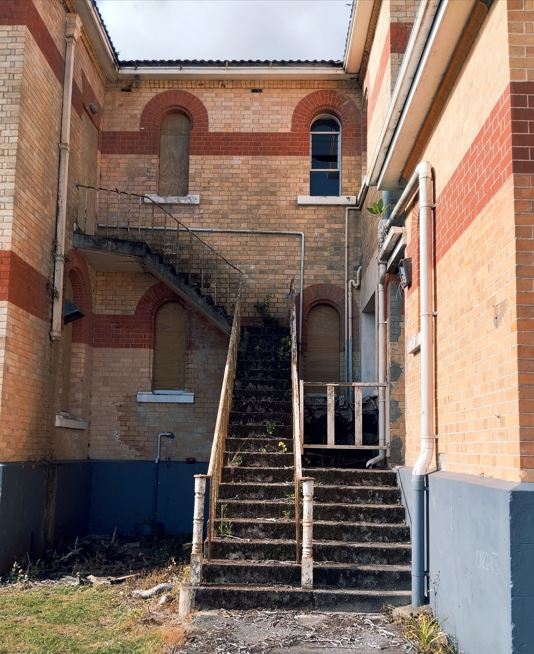
Carrington
At 17, I moved to Auckland, signed up for 50K in student loans, and fell in love with a Victorian monolith. Not in an objectophilia, Vice documentary, rubbing my nightie-clad body against the grimy brick and moaning kind of way, but as soon as I saw the building once named Auckland Provincial Lunatic Asylum, I knew I wanted to know as much as possible about the checkered history behind the beautiful facade.
On the first day of my undergraduate degree, I suffered a massive, shuddering panic attack. The entire first year class were seated on the grass at the front of the building, being welcomed with a powhiri, but my body rebelled. I stood up and ran away in front of 120 of my peers. At that point, more than 25 years ago, I had no idea I would be diagnosed with three crippling anxiety disorders. But the irony of being a crazy girl in a building made to house crazy girls has never been lost on me.
The agoraphobic panic attacks, as I would soon know to call them, felt as though my entire body was betraying me. Remaining in my seat in the lecture theatre, while my long-suffering tutors tried to impart a lifetime of knowledge about art, design, creativity and practice, was almost impossible for me. When the panic starts, you try to close it down, to over correct and suffocate it in your mind-vice. But panic is stronger than your will and it takes over the parts of your body you cannot control - the involuntary reflexes that make you sweat, shake, palpitate, vomit, pee and worse. My abject fear that one of these systems would fail me, filled my consciousness to such an extent that I struggled to engage in my course work in any discernible way.
A therapist once told me that having an anxiety disorder (or any mental health condition) is like having an additional full-time job draining your psychological capacity 24 hours a day. Continuous panic attacks exhaust you in ways that you cannot hope to explain to someone who has never experienced them. In the face of such a Sisyphean battle, I should have grown to hate the very sight of Building One. Instead, I retreated into the building, concentrating on the endless details, patterns, inconsistencies, and historic narratives. My favourite place became a toilet on the ground floor, under the stairs, nestled beside the elevator. It was so private and closed off that I felt able to breathe. Covered in sketches, stickers and stencils from other student’s work, the only window looked out through 1970’s louvered glass panes onto the very back of an internal courtyard where no one would bother to lurk. It was an oasis from my fear of embarrassing myself to the point of having to move home and live like a shut-in until my dying day.
Why did a building made to incarcerate, torture and erode people with mental health conditions, make me feel safe and understood like no place I have been since? Maybe I was just a weird kid who liked creepy, gothy things and wore too much black? Or perhaps there was something about the place, imbued with a sense of purpose, of creative endeavour that allowed me the space to be crazy while not being ostracised? During these years I made some of my closest lifelong friends. Friends who saw I was a gibbering, snotty mess but still wanted to hang out with me.
I saw a series of comments on an article in one of the major papers a few years ago about the sale and possible repurposing of Building One. Two friends were commenting that it should all be torn down. It was not fit for purpose, had bad mojo and was a drain on Auckland taxpayers. I wanted so badly to scream in their faces ‘But what about the thousands of students who have come through these walls? Do they not matter?’.
As Carrington Polytechnic and then Unitec, it became a place of learning, of creative endeavour, of young adults breaking free from their childhoods to find out who they are without the scaffolding of family right at our backs. We didn’t just learn to paint or to draw, we learned how to think critically, to extract information from a series of minute stimuli, to extrapolate meaning and look deeply at the world around us. The change in the atmosphere from a place of misery to a place of belonging was tangible over the 30 years it was a polytechnic. Yes, historically it was a place where funding was often so short, patients were left to rot, died of diseases that should have been eradicated years before, and in many cases became more insane than when they came in.
But if that land is soaked with 100 years of the blood of unfortunate people, shouldn’t we remember them? Shouldn’t we try to learn from the past and how poorly we have treated people with mental health conditions, rather than knock it down and pretend we are so great and kind now because we let people deteriorate on the streets or in jail rather than in a different institution?
Have we learned anything from back then? Because if you have tried to engage with our Mental Health System in the past few years, you will know that there is limited support, no money and even less sympathy available to anyone who doesn’t have the cash to pay for private care.
Even if Building One had not become an institution for higher learning, does that mean it is a waste of overpriced land and taxes?
Historically, people who were sent to the asylum were not expected to return home. Most died in situ, in desperate conditions. Having worked in heritage institutions for most of my adult life I can tell you that the stories of these people, most of whom were just thrown away for being ‘too much work’ is not recorded anywhere. The social history of people with mental illness is not retained in any tangible way, unless they were famous, or very wealthy.
Building one still holds many of the experiences, wisdom and knowledge of the people who lived there, if we are willing to look for it.
A brief walk around the outside of the main building, which is terrifyingly easy as there are no barriers, guards or even the most cursory security features afforded to the property by its current owners, will tell you the story of people who existed there. They left their initials, their dates, they wrote messages, and left marks warding off the evils they were experiencing. Apotropaic marks scraped into the bricks in the airing court tell of the beliefs from the residents. These marks, as well as the thousands of similar mementos held inside the building, need to be recorded, to be studied and to be retained in some tangible way for the future.
If you have ever tried to undertake any sort of historical research, you will know that we only have stories of the past if someone bothers to keep them. ‘History is told by the winners’ is a true aphorism, but ‘history is told by those wealthy enough to have the time and the function to record their experience’ is just as true. ‘Mental patients’ of the past didn’t make their marks for others to find, they were told no one would want to know about them or their lives. They were cast aside, families told that they would be ‘maintained’ by the state, by people who knew what they were doing, when in fact they were locked up and left to die. However, so many of them still found the drive to etch out their presence in the bricks, the wood and the concrete of their cage.
Just like those lost souls, 30+ years of students creating art, design, construction, architecture, photography, jewellery and sculpture within the rooms and corridors of building one, has left an indelible mark on the structure, on the wairua, the very soul of the land on which it sits. The innate superiority of colonial voices (usually white, wealthy and male) disregards history it doesn’t agree with. It does not privilege diverse voices, those of women, people of colour, as well as people who suffer with mental health conditions. Ignoring their stories will only make society less rich, less varied and more beige.
I like to think about how I would feel, had I been born 100 years ago, married off to an unsympathetic man, agonizingly birthed a dozen babies, lost a few and then deemed ‘insane’ because I struggled to cope with the terror of my own existence. If I had been locked away at Carrington, would I want someone to record a memory of me?
If I had affixed the walls with a series of circular witches’ marks in hopes that the old magic might betray on me some kind of safety and clemency, would I want it to be turned to rubble and replaced with a white box for wealthy people to rent out as an overpriced Air B’n’B?
I think I would prefer the space be used for the common good, third spaces to meet and connect, gardens, light, sun and air. Just as Thomas Story Kirkbride and Dorothea Dix intended when they crafted treatise on the ethical treatment of the mentally ill way back in the mid-18th century.
“The erasure of these historically layered, three-dimensional documents is an unacceptable waste of embodied energy and cultural memory. Other cultures have adaptively repurposed buildings with difficult and contested pasts, as a way of living with and learning from their histories. Can’t we?” [Dr Robert Kirkbride, “Transforming Memory: An Adaptive Reuse Studio for Three Kirkbride Plan Hospitals,” Preservation Works, August 13, 2023]
